Protect Canadian Cultural Sovereignty: Recommendations for the Government of Ontario

The Provincial Arts Service Organizations of Ontario represent and support creative workers, artists, and organizations engaged in all artistic disciplines that create and disseminate the arts in Ontario. Our organizations work together to strengthen the arts and culture environment to benefit the millions of Ontarians, Canadians, and visitors from around the world who experience the arts across the province.  

Ontario’s arts and culture sector contributes $27 billion to the provincial GDP, and provides almost 300,000 jobs–more jobs than in real estate, auto-manufacturing, forestry and mining combined.[1] Our province is home to 81,000 professional artists, 40% of the artists in Canada. Arts and culture tourism itself contributes $10 billion in provincial GDP, and over $4 billion in tax revenue.[2] The average arts and culture trip has nearly triple the economic impact of non-arts and culture trips. Attending performances and visiting galleries are key cultural tourism activities.[3]

While the sector generates powerful economic return, the people who power the arts in Ontario are economically vulnerable, and U.S.-imposed export tariffs would exacerbate their challenges. Ontario’s artists are already at significant disadvantage, with a median personal total income of $29,600, 41% less than other workers.  In Toronto, for example, despite median income levels of all workers rising by 13%, between 2016 and 2021 artists’ incomes declined by 28%.[4] Arts workers, too, earn disproportionately less than their non-arts counterparts. In 2022, the job vacancy rate in Ontario’s arts, heritage, and entertainment sector was 8.4.%. Nationally, with an average hourly wage offered of $18.40, wages for jobs in the arts were the third lowest among twenty industry sectors.  Highly skilled and educated arts workers can no longer afford to work in the sector.

In 2022 Ontario had a large cultural trade deficit of $1.3 billion, one of the largest provincial cultural trade deficits in Canada.  Beyond the sector’s economic impact, the arts are central to fostering social and cultural cohesion. They bolster a sense of belonging, and they facilitate community connection and engagement. In response to potential tariffs placed on Canadian exports, and to resist the American cultural imperialism that has grown with the digital age, it’s critical that the Government of Ontario address the situation with the urgency it demands, and protect the future of Canadian cultural sovereignty.  

On behalf of Ontario’s artists, arts workers, and organizations, we urge the next Government of Ontario to act on the following priorities: 

1. Increase funding at the Ontario Arts Council by $40 million annually

The Ontario Arts Council (OAC) is the economic lifeblood of the province’s arts and culture sector. By disseminating investments through a peer-adjudication process, the OAC’s methods are efficient, accessible, and enable strong return on investment. Organizations that receive annual support from the OAC alone contribute $1 billion to the provincial GDP. In 2024-25, a total investment of $37 million will help 560 organizations to generate over $980 million in additional annual revenues. 

Despite the demonstrated impact of arts investment through the OAC, annual baseline funding for the OAC has been frozen since 2009. This lack of investment, set against rapid increases in inflation and rising cost of living–and now a potential trade war–is exacerbating the precarity experienced by hundreds of thousands of creative professionals who live and work in the province.

An increased investment of $40 million annually will:

  • Support sole-proprietorships, small creative businesses and start-ups, and organizations across the province to increase earned revenue; 
  • Enhance local economies through OAC’s investment focus on Northern, Southwestern, and Eastern communities;  
  • Increase arts and culture tourism, and the economic impact it generates;
  • Generate new tax revenue and add tens of thousands of new jobs; 
  • Enable efficient, responsive, province-wide sectoral investments throughout a time of economic uncertainty. 

2. Strengthen the Status of Ontario’s Artists Act

The Status of Ontario’s Artists Act (2007) recognizes that artists make contributions to Ontario’s economy and quality of life, defines the occupation of professional artist, and includes several broad, voluntary commitments for the government to support artists and the arts and culture sector.[5]

While the legislation is helpful in demonstrating a basic commitment to the arts and culture sector, additional provisions can improve the labour environment–and subsequently the socioeconomic conditions–for Ontario’s self-employed artists by providing a framework for their legal and economic rights.  

The federal Status of the Artist Act supports the relations between artists and producers and ensures the protection of their basic legal and economic rights. Other provinces have enacted similar legislation; for example, Quebec recently passed significant improvements to its Status of the Artist legislation.

Addressing sectoral challenges
In Ontario, self-employed artists are often presented with insufficient contracts and agreements. When these agreements do not include standard provisions that outline, for example, the use of intellectual property, or the payment of artist fees, challenges arise that result in unnecessary inefficiencies for both parties. A significant portion of labour issues impacting self-employed artists could be addressed with a proper legislative framework. 

Supporting artists’ incomes
While unions and trade associations like Canadian Actors Equity Association (CAEA), the Alliance of Canadian Cinema, Television, and Radio Artists (ACTRA) and the Canadian Federation of Musicians (CFM) are positioned to uphold industry standard fees and bargain collective agreements, self-employed artists in other disciplines are unable to access this level of labour support. Artist associations including Canadian Artists Representation/le front des artistes canadiens (CARFAC), Canadian Alliance of Dance Artists, and the Independent Media Arts Alliance, establish industry standard fees for artists working in their corresponding disciplines, but without the proper recognition are not positioned to bargain on behalf of their respective memberships. 

We recommend the next Government of Ontario conduct an evaluation and consultation process with the goal to strengthen the Status of Ontario’s Artists Act. 

3. Increase access to arts spaces by facilitating cross-sector partnerships to utilize underused commercial spaces 

Background 
The compound effect of artists’ low wages, decades of stagnating public investment in the arts sector, and the rising cost of living and doing business results in significantly decreased access to critical creation, production, presentation, and administration space for artists and arts organizations. 

Meanwhile, many sectors are experiencing major changes in how they utilize office space, with more employees working remotely, or in a hybrid arrangement. In 2016, 7.1% of Canadians worked mostly from home. While this percentage peaked at almost 25% during the pandemic, in 2024 almost 19% of Canadian workers continue to work mostly from home.[6] According to a 2023 survey, 62% of Canadian employers are using a hybrid working model, and 52 per cent of employers said they intend to keep the same amount of office space, while 27 per cent said they need less space.[7] Given these shifts in the labour environment, it’s not surprising that over 20% of Toronto’s office space is available for lease.[8] This trend has also raised concerns about the effect of remote work on local economies. 

Opportunities for cross-sectoral impact
By providing incentives to companies and organizations holding empty and underutilized office space, the Government of Ontario can facilitate partnerships across sectors, while increasing availability of and access to “meanwhile” spaces. The Provincial Arts Service Organizations of Ontario are well positioned to consult with the government and with the private sector on logistical elements like identifying appropriate mediums for various spaces, short-term lease agreements, and how to facilitate positive and productive environments that bring together artists and other workers. As colleagues in the tech industry are well aware, facilitating intentional collisions incubates a myriad of downstream impacts and opportunities for both artistic and industry leaders.   

Similar initiatives are being piloted in other provinces. In Vancouver, for example, a former motel has been transformed into The City Centre Artist Lodge offering 79 low-cost work-only artist spaces that prioritize underrepresented and marginalized artists.[9] But creating limited-time studio space for artists within occupied but underutilized office spaces can be facilitated with greater ease and minimal resources.  

On behalf of: 

Alliance culturelle de l’Ontario
Artist-Run Centres & Collectives of Ontario (ARCCO)
ArtsBuild Ontario  
Bureau des regroupements des artistes visuels de l’Ontario (BRAVO)
Canadian Artists’ Representation / le front des artistes canadiens (CARFAC) Ontario
Cultural Pluralism in the Arts Movement Ontario (CPAMO) 
Dance Ontario  
Dance Umbrella of Ontario 
Galeries Ontario / Ontario Galleries 
Indigenous Curatorial Collective / Collectif des commissaires autochtones (ICCA) 
Media Arts Network of Ontario (MANO)
Ontario Culture Days
Ontario Presents 
Orchestras Canada/Orchestres Canada
Théâtre Action 
Toronto Alliance for the Performing Arts (TAPA)
Work in Culture (Cultural Careers Council Ontario)

Contact:
Jason Samilski, Executive Director, CARFAC Ontario | jason@carfacontario.ca  


[1]https://www.arts.on.ca/news-resources/news/2024/arts-across-ontario-study-reveals-billion-dollar-impact-on-ontario-gdp-by-oac-funded-organizations

[2]https://www.arts.on.ca/oac/media/oac/Publications/Research%20Reports%20EN-FR/Arts%20Participationand%20Audiences/O

[3]https://www.arts.on.ca/oac/media/oac/Publications/Research%20Reports%20EN-FR/Arts%20Participationand%20Audiences/Ontario-Arts-and-Culture-Tourism-Profile-2023-Final-EN-DesignVer-FINAL-s.pdf

[4]https://www.toronto.ca/legdocs/mmis/2024/ec/bgrd/backgroundfile-249453.pdf

[5] https://www.ontario.ca/laws/statute/07s07

[6] www150.statcan.gc.ca/n1/daily-quo0dien/240826/dq240826a-eng.htm

[7] www.benefitscanada.com/news/bencan/62-of-canadian-employers-using-hybrid-working-model-survey/

[8] www.avisonyoung.ca/web/toronto-gta/office-market-report

[9] https://narrowgroup.ca/project/city-centre-artist-lodge/
2024 Ontario Budget Consultations

On behalf of our members, and the 7000+ visual artists who live and work in the province, CARFAC Ontario submitted the following recommendations to the Government of Ontario that artists will be looking for in the 2024 provincial budget.

Recommendation #1 

We recommend that that the Government of Ontario increase investment at the Ontario Arts Council (OAC) by $3 million per year starting in 2024-25. 

Of the $27 billion provincial GDP contribution from arts and culture, approximately $5.5 billion comes from arts education, performing arts, festivals, original visual art, craft, books, and sound recordings–sectors that are heavily supported by the OAC. 

Committing to multi-year investment that aligns with increasing population growth and inflation projections is critical for the sector’s pandemic recovery. Growth of Ontario’s culture sector since 2010 was reversed by the pandemic. Between 2010 and 2019, Ontario’s cultural economy saw a real per capita increase of 4%; this was followed by a 7% decrease in 2020. Job trends in the sector follow a similar trajectory, increasing by 8% between 2010 and 2019, only to decrease in 2020 by 11%. Investment in the OAC is an efficient and cost-effective way to counteract these trends. For example, following conversations with OAC we know that in 2023-24 $37 million in annual operating support will be provided to 550 arts organizations, which will result in $900 million in additional revenues for these organizations. Investing in the OAC continues to represent the most effective way to both support the sector and produce powerful economic return for the province. 

Recommendation #2

As a no-cost market-based strategy to improve the labour environment for creators, and to strengthen Ontario’s cultural economy, we recommended that the Government of Ontario work with Ontario’s artists and arts organizations to launch a consultation process to evaluate and improve the Status of Ontario’s Artists Act.

The Status of Ontario’s Artists Act can strengthen Ontario’s arts and culture economy by undergoing modernizations that promote equitable pay, and provide adequate labour conditions for artists and creators across all disciplines. Such improvements are important, especially given that 65% of Canadian artists are self-employed, which is significantly higher than the self-employment rate of the overall Canadian labour force (14-16%), and given that the median income for visual artists is approximately $20,000, with many artists living under the low-income cut-off. And as the rapid release and commercial adoption of Generative Artificial Intelligence products continues to disproportionately impact artists through the unauthorized use of their intellectual property as well creating labour disruptions, the Government of Ontario should act now, and use this available tool to improve socioeconomic conditions for all artists in the province.  

Recently, Quebec enacted significant updates to its Status of the Artist legislation that now provides artists with better labour protections, sets out basic required terms for commissioning and presentation contracts, and enables professional arts associations to negotiate collective agreements. 

Artists are vulnerable to exploitative labour practices; for example, we hear from many artists who are offered licensing and presentation opportunities where no written agreement is provided. When conflicts arise, professional guidance, mediation, and legal support often falls to artist associations like CARFAC. And while the CARFAC-RAAV Minimum-Recommended Fee Schedule is understood nationally as the industry standard for paying visual and media artists, with federal institutions required to use these guidelines when engaging artists, the current Status of Ontario’s Artists Act does not afford creators such protections. Strengthening current legislation can reduce both labour exploitation and the inefficiencies associated with remedying conflicts. 

Working toward improving the Status of Ontario’s Artists Act legislation should begin with sector-wide consultations, which can be developed in collaboration Ontario’s Provincial Arts Service Organizations, and other stakeholders.  

Ontario Artists’ Legal Access & Support Network Presents: “Just Between Us: Advice for Artists by Artists”

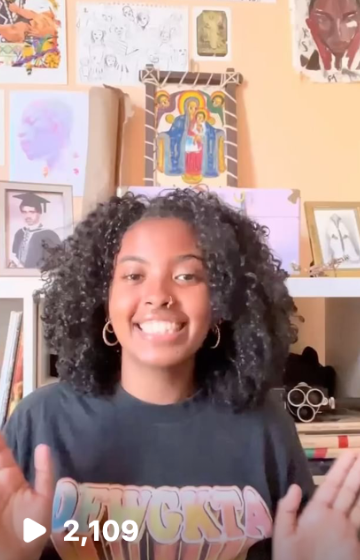
“Just Between Us: Advice for Artists by Artists” is a nine-part virtual series based in arts advocacy and community care. Presented by the Ontario Artists’ Legal Access & Support Network and directed by Imani Dominique, this Instagram and TikTok based series aims to inform and empower other artists with tools for self-advocacy. “Just Between Us: Advice for Artists by Artists”,  embodies the spirit of “each one teach one” by pooling and amplifying knowledge from nine incredible Canadian artists: Alicia Reid, Anthony Gebrehiwot, Daej Hamilton, Dequiera Atherton, Gerda Boateng, Kaya Joan, Nala Haileselassie, Pauline Nguyen, and Selina Mccallum. The artists’ practices span across artistic disciplines, including photography, film, woodworking, writing, curation, illustration, motion design, and public art. Throughout the series, the artists share lessons learned, advice for other creatives, and insight into their artistic practices. 

Episode One: Just Between Us: Advice for Artists by Artists with Nala Haileselassie

Just between us, are you a self-taught artist? How have you navigated the art world? What do you wish you knew when you started out? 

We all have moments where we wish we had known better. Regardless of how things turned out, it’s always helpful to share our experiences. By doing so, we can build networks of community care and support. In this video, Nala Haileselassie shares her advice for artists navigating the industry along with some tips for self-teaching. 

Nala Haileselassie is a multidisciplinary artist from Toronto, CA whose practice spans across video, printmaking, and illustration. 

Episode Two: Just Between Us: Advice for Artists by Artists with Daej Hamilton

Just between us, how do you determine the value of your artwork? 

There are often numerous factors to take into consideration when it comes to pricing your work. Knowing your worth takes time but always remember that you should feel intrinsically affirmed by what you decide. Never forget that “your work matters!”. In this video, Daej Hamilton shares her advice for artists when it comes to negotiating your prices. 

Based in Toronto, founder, and principal designer, Daej Hamilton started this company at 22 years old. Luxuriating in her 11th year of woodworking, her pieces reflect the timeless, mid-century, modern aesthetic. Using some of the finest woods, her work is designed and hand crafted to complement form and function. 

Episode Three: Just Between Us: Advice for Artists by Artists with Pauline Nguyen

Just between us, have you heard of the term “informed consent”? What about in the context of creative collaboration and/or labor? If not, this video is for you!

When navigating creative collaborations, it is critical that everyone involved clearly understands the terms of their agreement. This can help reduce the odds of conflict occurring down the road and can ensure that the collaboration runs smoothly. In this video, Pauline Nguyen introduces the concept of “informed consent” and emphasizes its importance when facilitating events and working collaboratively with artists.

Pauline Nguyen’s creative practice is based in 35mm film photography and community/public arts engagement. Much of their ongoing photo work consists of explorations of spacetime, care, and orientations towards the world and others. 

Episode Four: Just Between Us: Advice for Artists by Artists with Anthony Gebrehiwot

Just between us, we’ve all been on the receiving end of a late payment. But what happens when you’re a freelance artist and have yet to receive numerous payments? Anthony Gebrehiwot shares his thoughts on the importance of paying artists on time. 

Anthony Gebrehiwot is an award winning visual artist, photographer and community leader whose creative lens re-visions photography as an ongoing dialogue of social change between subject and society. 

A self-taught artist and photographer, Gebrehiwot founded XvXy-photo in 2014 focusing on studio portraiture. To date, he has worked with several notable brands such as Nike, Royal Bank of Canada, Vice Canada, Absolute, Hudson Bay, The City of Toronto and Linkedin to name a few. His work has been featured in over thirty local and international publications such as the Star, the Globe and Mail, PAPER Magazine, Elle UK and Yahoo Lifestyle.

Episode Five: Just Between Us: Advice for Artists by Artists with Selina Mccallum

Just between us, when working with brands or doing a private commission, it’s important to accurately calculate your artist fee.

An artist fee is the amount of money that you would like to be paid after expenses are covered. However, when numbers start to add up and your overall price begins to escalate, presenting your final quote to a client can feel daunting. How can artists overcome this obstacle? In this video, Selina Mcallum shares advice for determining your artist fee and shares how knowing your worth can be your most valuable negotiation tactic.
Selina McCallum was born and raised in Toronto, Ontario by her Tanzanian mother and Jamaican father. She started her own photography and videography business called Shot By Selina in 2016. Selina graduated from the University of Windsor with a double degree in Digital Journalism and Communications, Media and Film in May 2019. She is currently freelancing in videography and photography as well as enhancing her digital skills by taking an intensive course in VFX.

Episode Six: Just Between Us: Advice for Artists by Artists with Dequiera Atherton

Just between us, have you ever collaborated with another artist? If so, what were some of the things you enjoyed about the experience? Is there anything you would change?

Artist collaborations are an important part of building community and creating incredible work. Creating with other artists can help expand your skillset and your perspective. In this video, Dequiera Atherton shares advice for collaborating with other artists to create amazing work and share experiences.

Dequiera Atherton also known as Cozy DQ is an artist that likes to experiment with different digital mediums. She started off with graphic design, illustration, and then migrated to photography. Now she is currently working on commercial finishing, motion design, and VFX.  

Episode Seven: Just Between Us: Advice for Artists by Artists with Kaya Joan

Just between us, do you know how to establish the grounds of a working relationship? 

Knowing and establishing your boundaries are so important when building relationships. When you  establish parameters for working relationships and have these agreements in writing, you can better enforce your rights and self-advocate down the line. In this video, Kaya Joan shares advice for navigating unfair power dynamics and trusting your intuition. 

Kaya Joan is a multi-disciplinary Afro-Indigenous (Vincentian, Kanien’kehá:ka with relations from Kahnawá:ke, Irish, Jamaican) artist born, raised and living in T’karonto, Dish with One Spoon treaty territory. Kaya’s work focuses on relationship to place and storytelling. Black and Indigenous futurity are also centered in Kaya’s practice, framing methods of making as ancestral tools to unpack and transform buried truths, opening portals 7 generations into the past and future. Kaya has been working in community arts for 7 years as a facilitator and artist, and is a member of Milkweed Collective. 

Episode Eight: Just Between Us: Advice for Artists by Artists with Alicia Reid

Just between us, have you ever used a photo release form?

When sharing work that uses the likeness of another individual, it’s necessary to use a photo release form, media release, or model release agreement. These forms allow you to use their image in your artwork and protects you from potential legal issues in the future. If you would like to create a release form, we encourage you to visit carfacontario.ca to find contract templates. In this video, Alicia Reid shares when and why you should  create a photo release form.

Alicia Reid is a Jamaican-Canadian Prize-winning photographer and aspiring filmmaker based in Toronto. Born and raised in Scarborough, her work is inspired by Caribbean and Toronto culture as she loves sharing moments that highlight people of colour. Specializing in events and concert photography, she has been doing photography for over 5 years and has been featured on media outlets including the Toronto Star, Global News and Complex Music. Her purpose as an artist is to create a positive outlook to be shown in the city especially towards people in marginalized communities and her goal is to continue to change the narrative of places in the city that are often misrepresented.

Episode Nine: Just Between Us: Advice for Artists by Artists with Gerda Boateng

Just between us, how do you protect your artwork?

When creating and sharing your work, it is so important to ensure that you are protected. While your rights to your work are already protected through Canadian copyright laws, it can be difficult to protect your work from digital theft. Watermarks and signatures, and logos are great ways to let people know that you own your work. If you would like to learn more about copyright and other forms of artistic protection, we encourage you to visit carfacontario.ca.

In this video, Gerda Boateng shares valuable tips for protecting your artwork from theft. Gerda Boateng is a Ghanaian Canadian, multi-disciplinary creative. The goal of her work is to showcase unconventional standards of beauty. More specifically, to show women of colour they are art too.  With her Bachelors in Design from OCAD university Gerda has a thorough understanding of how consumers think in regards to brands, products, and art. Gerda’s Mission is to continue to move the conversation of representation forward by designing creative concepts, showing that the idea of beauty is way more than skin deep. She hopes to motivate people to look at themselves as art, and inspire them to truly love themselves from the inside out!

“Just Between Us: Advice For Artists by Artists” premiered on August 11, 2022 via Instagram and TikTok. Since its initial release, it has reached thousands of people across platforms. Each One Teach One.

The Ontario Artists’ Legal Access & Support Network is a collaboration between CARFAC Ontario artists and ALAS (Artists’ Legal Advice Services) lawyers. This collaboration has been formed to provide free legal advice and information, non-legal peer support, and resources for artists related to their practices, particularly artists who lack access to these kinds of support because of overlapping systemic barriers such as racism, homophobia, transphobia, and/or misogyny. CARFAC Ontario is dedicated to promoting the wellbeing of  Ontario’s visual artists, and advancing the visual arts as a practice. ALAS (Artists’ Legal Advice Services) provides free summary legal advice and information to creators living in Ontario, Canada. With services spanning from contract templates to drop-in legal clinics, both organizations work to create and disseminate legal resources for artists. 

Imani Dominique Busby is an independent curator and visual artist based in Toronto. She is presently studying Creative Industries at Toronto Metropolitan University. She aspires to become a curator and art lawyer with the goal of supporting marginalized artists as they navigate the art industry. With roots in creativity and entrepreneurship,  Imani is passionate about the art and fashion industries, representation, and community building.

“Just Between Us: Advice for Artists by Artists” was funded by the Ontario Trillium Foundation, The Law Foundation of Ontario, Canada Council for the Arts, Ontario Arts Council, and Toronto Arts Council