Protect Canadian Cultural Sovereignty: Recommendations for the Government of Ontario

The Provincial Arts Service Organizations of Ontario represent and support creative workers, artists, and organizations engaged in all artistic disciplines that create and disseminate the arts in Ontario. Our organizations work together to strengthen the arts and culture environment to benefit the millions of Ontarians, Canadians, and visitors from around the world who experience the arts across the province.  

Ontario’s arts and culture sector contributes $27 billion to the provincial GDP, and provides almost 300,000 jobs–more jobs than in real estate, auto-manufacturing, forestry and mining combined.[1] Our province is home to 81,000 professional artists, 40% of the artists in Canada. Arts and culture tourism itself contributes $10 billion in provincial GDP, and over $4 billion in tax revenue.[2] The average arts and culture trip has nearly triple the economic impact of non-arts and culture trips. Attending performances and visiting galleries are key cultural tourism activities.[3]

While the sector generates powerful economic return, the people who power the arts in Ontario are economically vulnerable, and U.S.-imposed export tariffs would exacerbate their challenges. Ontario’s artists are already at significant disadvantage, with a median personal total income of $29,600, 41% less than other workers.  In Toronto, for example, despite median income levels of all workers rising by 13%, between 2016 and 2021 artists’ incomes declined by 28%.[4] Arts workers, too, earn disproportionately less than their non-arts counterparts. In 2022, the job vacancy rate in Ontario’s arts, heritage, and entertainment sector was 8.4.%. Nationally, with an average hourly wage offered of $18.40, wages for jobs in the arts were the third lowest among twenty industry sectors.  Highly skilled and educated arts workers can no longer afford to work in the sector.

In 2022 Ontario had a large cultural trade deficit of $1.3 billion, one of the largest provincial cultural trade deficits in Canada.  Beyond the sector’s economic impact, the arts are central to fostering social and cultural cohesion. They bolster a sense of belonging, and they facilitate community connection and engagement. In response to potential tariffs placed on Canadian exports, and to resist the American cultural imperialism that has grown with the digital age, it’s critical that the Government of Ontario address the situation with the urgency it demands, and protect the future of Canadian cultural sovereignty.  

On behalf of Ontario’s artists, arts workers, and organizations, we urge the next Government of Ontario to act on the following priorities: 

1. Increase funding at the Ontario Arts Council by $40 million annually

The Ontario Arts Council (OAC) is the economic lifeblood of the province’s arts and culture sector. By disseminating investments through a peer-adjudication process, the OAC’s methods are efficient, accessible, and enable strong return on investment. Organizations that receive annual support from the OAC alone contribute $1 billion to the provincial GDP. In 2024-25, a total investment of $37 million will help 560 organizations to generate over $980 million in additional annual revenues. 

Despite the demonstrated impact of arts investment through the OAC, annual baseline funding for the OAC has been frozen since 2009. This lack of investment, set against rapid increases in inflation and rising cost of living–and now a potential trade war–is exacerbating the precarity experienced by hundreds of thousands of creative professionals who live and work in the province.

An increased investment of $40 million annually will:

  • Support sole-proprietorships, small creative businesses and start-ups, and organizations across the province to increase earned revenue; 
  • Enhance local economies through OAC’s investment focus on Northern, Southwestern, and Eastern communities;  
  • Increase arts and culture tourism, and the economic impact it generates;
  • Generate new tax revenue and add tens of thousands of new jobs; 
  • Enable efficient, responsive, province-wide sectoral investments throughout a time of economic uncertainty. 

2. Strengthen the Status of Ontario’s Artists Act

The Status of Ontario’s Artists Act (2007) recognizes that artists make contributions to Ontario’s economy and quality of life, defines the occupation of professional artist, and includes several broad, voluntary commitments for the government to support artists and the arts and culture sector.[5]

While the legislation is helpful in demonstrating a basic commitment to the arts and culture sector, additional provisions can improve the labour environment–and subsequently the socioeconomic conditions–for Ontario’s self-employed artists by providing a framework for their legal and economic rights.  

The federal Status of the Artist Act supports the relations between artists and producers and ensures the protection of their basic legal and economic rights. Other provinces have enacted similar legislation; for example, Quebec recently passed significant improvements to its Status of the Artist legislation.

Addressing sectoral challenges
In Ontario, self-employed artists are often presented with insufficient contracts and agreements. When these agreements do not include standard provisions that outline, for example, the use of intellectual property, or the payment of artist fees, challenges arise that result in unnecessary inefficiencies for both parties. A significant portion of labour issues impacting self-employed artists could be addressed with a proper legislative framework. 

Supporting artists’ incomes
While unions and trade associations like Canadian Actors Equity Association (CAEA), the Alliance of Canadian Cinema, Television, and Radio Artists (ACTRA) and the Canadian Federation of Musicians (CFM) are positioned to uphold industry standard fees and bargain collective agreements, self-employed artists in other disciplines are unable to access this level of labour support. Artist associations including Canadian Artists Representation/le front des artistes canadiens (CARFAC), Canadian Alliance of Dance Artists, and the Independent Media Arts Alliance, establish industry standard fees for artists working in their corresponding disciplines, but without the proper recognition are not positioned to bargain on behalf of their respective memberships. 

We recommend the next Government of Ontario conduct an evaluation and consultation process with the goal to strengthen the Status of Ontario’s Artists Act. 

3. Increase access to arts spaces by facilitating cross-sector partnerships to utilize underused commercial spaces 

Background 
The compound effect of artists’ low wages, decades of stagnating public investment in the arts sector, and the rising cost of living and doing business results in significantly decreased access to critical creation, production, presentation, and administration space for artists and arts organizations. 

Meanwhile, many sectors are experiencing major changes in how they utilize office space, with more employees working remotely, or in a hybrid arrangement. In 2016, 7.1% of Canadians worked mostly from home. While this percentage peaked at almost 25% during the pandemic, in 2024 almost 19% of Canadian workers continue to work mostly from home.[6] According to a 2023 survey, 62% of Canadian employers are using a hybrid working model, and 52 per cent of employers said they intend to keep the same amount of office space, while 27 per cent said they need less space.[7] Given these shifts in the labour environment, it’s not surprising that over 20% of Toronto’s office space is available for lease.[8] This trend has also raised concerns about the effect of remote work on local economies. 

Opportunities for cross-sectoral impact
By providing incentives to companies and organizations holding empty and underutilized office space, the Government of Ontario can facilitate partnerships across sectors, while increasing availability of and access to “meanwhile” spaces. The Provincial Arts Service Organizations of Ontario are well positioned to consult with the government and with the private sector on logistical elements like identifying appropriate mediums for various spaces, short-term lease agreements, and how to facilitate positive and productive environments that bring together artists and other workers. As colleagues in the tech industry are well aware, facilitating intentional collisions incubates a myriad of downstream impacts and opportunities for both artistic and industry leaders.   

Similar initiatives are being piloted in other provinces. In Vancouver, for example, a former motel has been transformed into The City Centre Artist Lodge offering 79 low-cost work-only artist spaces that prioritize underrepresented and marginalized artists.[9] But creating limited-time studio space for artists within occupied but underutilized office spaces can be facilitated with greater ease and minimal resources.  

On behalf of: 

Alliance culturelle de l’Ontario
Artist-Run Centres & Collectives of Ontario (ARCCO)
ArtsBuild Ontario  
Bureau des regroupements des artistes visuels de l’Ontario (BRAVO)
Canadian Artists’ Representation / le front des artistes canadiens (CARFAC) Ontario
Cultural Pluralism in the Arts Movement Ontario (CPAMO) 
Dance Ontario  
Dance Umbrella of Ontario 
Galeries Ontario / Ontario Galleries 
Indigenous Curatorial Collective / Collectif des commissaires autochtones (ICCA) 
Media Arts Network of Ontario (MANO)
Ontario Culture Days
Ontario Presents 
Orchestras Canada/Orchestres Canada
Théâtre Action 
Toronto Alliance for the Performing Arts (TAPA)
Work in Culture (Cultural Careers Council Ontario)

Contact:
Jason Samilski, Executive Director, CARFAC Ontario | jason@carfacontario.ca  


[1]https://www.arts.on.ca/news-resources/news/2024/arts-across-ontario-study-reveals-billion-dollar-impact-on-ontario-gdp-by-oac-funded-organizations

[2]https://www.arts.on.ca/oac/media/oac/Publications/Research%20Reports%20EN-FR/Arts%20Participationand%20Audiences/O

[3]https://www.arts.on.ca/oac/media/oac/Publications/Research%20Reports%20EN-FR/Arts%20Participationand%20Audiences/Ontario-Arts-and-Culture-Tourism-Profile-2023-Final-EN-DesignVer-FINAL-s.pdf

[4]https://www.toronto.ca/legdocs/mmis/2024/ec/bgrd/backgroundfile-249453.pdf

[5] https://www.ontario.ca/laws/statute/07s07

[6] www150.statcan.gc.ca/n1/daily-quo0dien/240826/dq240826a-eng.htm

[7] www.benefitscanada.com/news/bencan/62-of-canadian-employers-using-hybrid-working-model-survey/

[8] www.avisonyoung.ca/web/toronto-gta/office-market-report

[9] https://narrowgroup.ca/project/city-centre-artist-lodge/

Introducing the CARFAC Ontario Artist Resource Library

We are pleased to share with you the new CARFAC Ontario Resource Library—a new and updated series of informational notes, templates, tools, and contracts intended to offer professional information and support for your artistic practice.

The Resource Library is free for all CARFAC members, non-members will be able to access resources by purchase. 

HOW TO

Download a resource

  1. Log into your member’s portal
  2. Go to the Resource Library
  3. Click on any resource you need and “Add to Cart”
  4. Use “View Cart” or the cart icon on the top right, underneath the menu bar
  5. Proceed to check-out, price should show $0* 
  6. Review and confirm
  7. A download link, available for 7 days, will be sent to your email
  8. Open your email, click the link, and the files will download directly**

*Please note a few resources are not free and are priced accordingly 

**Contract templates require a password to use which will be included in the email

Creation & EngagementThe artmaking and creation process and engaging with the community as an artist
Sales & ExhibitionHow to share & sell your work safely and successfully
CopyrightHow an artist can protect their work, and how an artist can ethically and legally use content
Career EssentialsAdministrative or “behind the scenes” work (non-financial or business related) required to maintain an artist’s practice
Business & FinancialsFinancial and business-related practices involved in sustaining an artist’s practice
NotesShort to medium form written documents
Tools & TemplatesWritten documents with some level of interactivity
ContractsTemplates of contracts for common scenarios artists face

Explore some examples of new resources written and designed to promote opportunity, ignite inspiration, and empower artists in all of their artistic endeavours.

The Resource Library is made possible by CARFAC Ontario members, with support from Canada Council for the Arts, Ontario Arts Council, and Toronto Arts Council.

Become a member and/or renew your membership with us

Interested in becoming a member? Check out other benefits!

CARFAC-RAAV’s recommendations regarding AI and visual artists

CARFAC-RAAV’s recommendations regarding AI and visual artists

Introduction

Canadian Artists’ Representation / Le Front des artistes canadiens (CARFAC) and le Regroupement des artistes en arts visuels du Québec (RAAV) are the national associations representing visual and media artists. Together we work to affirm the economic and legal rights of artists, many of whom have been deeply impacted by the nonconsensual use of their intellectual property by companies developing generative artificial intelligence (AI).

In 2023, the Government of Canada produced a Guide on the use of Generative AI , which describes what generative AI is, and introduces some of the main challenges, concerns, and potential solutions that have been identified. On January 15, 2024, we submitted briefs to the Government in response to a consultation on copyright in the age of generative AI . Our submission results from over 220 unique responses from artists to a national survey regarding their concerns about generative AI products; community dialogues at virtual panel events organized by CARFAC and RAAV in Ontario, Quebec, and Saskatchewan; and hundreds of hours connecting with artists and stakeholders across the cultural sector in Canada and abroad.

AI and the potential for copyright infringement

We are concerned about how generative AI companies interpret the laws that apply to their business models. Midjourney recently updated its terms of service to clarify that users may not use the product to violate others’ intellectual property rights, and that doing so may result in the company taking legal action against the user. Yet, the company has itself been accused of copyright infringement on multiple occasions. The terms of service goes on to state that the company does not guarantee that the service does not infringe on copyright.

Additionally, Open AI recently launched a program called Copyright Shield which promises to pay legal costs for its developer customers who face lawsuits over intellectual property claims. Assertions that these business practices are in compliance with the Copyright Act are inconsistent with these protective measures and also raise the question why some AI companies are ratifying licensing deals with major publishing and media providers, but argue against the use of licensing models for all content being used as training data.

Clarity around copyright and Text and Data Mining (TDM)

Using artwork obtained through TDM to train generative AI products without allowing artists to provide consent, negotiate compensation, or determine if/how they will be credited violates those artists’ rights under the Copyright Act. The Federal Government’s consultation is an opportunity for them to educate generative AI companies to ensure they comply with the law. 

Questions about moral rights are notably absent from the government’s survey; however, the violation of artists’ moral rights is inevitable based on the current business models used by most generative AI companies. It is common for generative AI models to distort original works which may harm the reputation of artists, and artists do not commonly have the choice to be credited or remain anonymous. Generative AI also enables an environment in which artists are unable to protect their works from association with causes, products, services, or institutions to which they are personally opposed. 

Eighty-two percent of artists responding to our survey indicated they were very or extremely concerned that their artwork is used without consent to train generative AI products. This concern is so deep and widespread that independent countermeasures are being taken. For example, the University of Chicago has developed Glaze, a tool that artists can use to protect their works online from becoming AI training data. While these efforts are appreciated, protecting the intellectual property rights of artists against non-consensual use by some of the world’s largest corporations should be done through copyright law and federal regulation. It should not rely solely on these independent initiatives.    

Terms such as “training data” are used frequently, and this language can devalue a creator’s intellectual property. For artists, this is not “training data”; this is their life’s work.

Challenges faced by rights holders in licensing their works for TDM activities

The plurality of stakeholders, the legal uncertainty, the need for more transparency in data management systems, and the opacity of AI systems are insurmountable obstacles for artists to defend their copyrights without support. The critical challenge currently faced by Canadian rights holders in licensing their works is the inability to determine what copyright-protected works have trained generative AI products; this opacity prevents parties from negotiating licensing terms and stifles the development of emerging licensing markets.

It is also challenging to establish that the infringing party had access to the original work, that the original work was the source of the copy, and that the work was significant in informing the creation of the new content produced. However, we understand that AI developers and researchers in the sector document their training data. Therefore, greater transparency of this data with rights holders is therefore technically feasible.

Most artists have yet to have opportunities to negotiate licenses for their works already used to train generative AI models. Though many mainstream generative AI companies do not employ licensing models, such business frameworks exist within the AI industry. Getty Images, for example, has released an AI Image Generator trained exclusively on its content. Getty compensates creators for the use of their work in their AI model.

Resistance from generative AI companies to engage in licensing negotiations with the arts sector is another critical challenge in establishing a market-based approach to consent and compensation for artwork used in TDM. Meta, for example, has argued that imposing a licensing regime after the fact would cause chaos for the industry and result in little benefit for artists, given the insignificance of their respective works within larger datasets. Already, however, we are seeing contradictions in these arguments. OpenAI recently entered a licensing deal with Axel Springer, the parent company of Business Insider and Politico; such an agreement could become the norm. Companies that regularly violate the Copyright Act should not benefit from an exemption on the grounds that those actions have already occurred. Even when the financial value of an individual work is small, this does not preclude the rights of artists to provide consent and receive payment for using that work. 

The Canadian Government should avoid entertaining arguments that complying with the Copyright Act and obtaining prior consent from artists would slow the development process of generative AI products. While AI technology may be complex, basic principles of fairness, justice, and asking permission before taking things are straightforward and baked into Canadian laws and social values. Generative AI companies are rightfully excited about the products they produce and understandably feel a sense of urgency to accelerate the development of those products. Artists are no different; we must regard their needs with the same level of importance, innovation, and urgency. Neither group can be permitted to operate outside of the law or develop their products in ways that harm individuals or society at large.  

Amending the Copyright Act to clarify the scope of permissible TDM activities

The Copyright Act is sufficient and applicable to protect the rights of creators in the context of generative AI. There is no reason to believe that current copyright laws do not, or should not, apply. Situations in which private companies use, without permission, the copyrighted works of Canadian artists to develop and grow the value of their commercial products is precisely the kind of scenario that the Copyright Act should prevent.

The Federal Government should refrain from implementing new fair dealing exceptions for TDM. Doing so would devastate the economic environment for Canadian artists – many of whom live at or under the poverty line. A TDM exception would result in long-term negative social and cultural externalities, including compromising the global competitiveness of Canadian arts and culture and harming small creative businesses. 

Proposed obligations on AI developers to keep records of copyright-protected content

The current environment must enable rights holders to determine if their works have been used to train generative AI models. An opaque operating model both encourages the unauthorized use of Canadian artists’ works by AI developers and prevents licensing negotiations from taking place. We, therefore, recommend that generative AI companies be required to publish records of copyright-protected works that have trained AI models.

Developers and researchers in the generative AI sector are already documenting their training data, for example, using model cards. Model cards can record structured information, such as the names of domains where training data is collected. Therefore, introducing a record-keeping obligation should not entail additional costs for the AI industry and would provide much-needed transparency.

Remuneration for the use of a given work in TDM activities

Canadian artists face growing labor disruptions due to the proliferation and use of AI-assisted and AI-generated content by businesses and consumers. This trend is unsurprising as organizations that once licensed the use of original works can now use generative AI to meet their needs without paying creators.

Artists and generative AI companies should negotiate remuneration for licenses without government intervention. This could be facilitated by collective licensing options to simplify the process so artists need not have to negotiate with companies on an individual basis, and this option is already being explored in several countries.

The Government can enable a market-based solution by ensuring that the generative AI companies operating within Canada comply with current Canadian copyright law without exception, and that records of copyright-protected works that trained AI products are made public. As generative AI has negatively impacted labour opportunities in our industry, the Federal Government can contribute to stabilizing this fallout by ensuring that generative AI companies operating in Canada adopt appropriate licensing models.

Authorship and ownership of content generated by AI 

Existing copyright laws are sufficient to address authorship and ownership, and no legal amendments are required. As the Supreme Court of Canada noted in CCH v. The Law Society of Upper Canada, “An original work must be the product of an author’s exercise of skill and judgment. The exercise of skill and judgment required to produce the work must not be so trivial that it could be characterized as a purely mechanical exercise”.

These same criteria should apply when evaluating the granting of copyright to AI-produced or AI-assisted works. Entering a series of text prompts into an AI Image Generator is decidedly a “purely mechanical exercise,” that does not require the user to exercise “skill and judgment.” There may be, however, other situations where AI-generated or AI-assisted artwork meets the criteria for copyright protection. For example, if artist designs an AI model and trains that model with their artwork so that the model can understand and interact with the training data in unique ways specified by the artist, the content resulting from this process may meet the copyright criteria.

The question of authorship of AI-generated works is essential but difficult to consider in a landscape where private companies use Canadian artists’ intellectual property without consent, credit, or compensation to develop their products and increase the value of those products. Suggestions that generative AI companies could be able to continue developing their products using unauthorized Canadian artists’ works while simultaneously considering if the resulting content generated by those products should receive copyright protection are concerning. The devastating impact this would have on the creative economy in Canada is profound and difficult to predict, though it is essential to highlight the specific effects on Indigenous artists and communities. As the theft of original Indigenous cultural expressions is already widespread, its unauthorized use by generative AI companies is unconscionable and contrary to notions of Truth and Reconciliation. Moreover, including counterfeit Indigenous artwork in training datasets accelerates the spread of counterfeit imagery, and the generation of AI content based on authentic or fake Indigenous artwork cannot be permitted. This issue deserves a separate analysis and consultation, and with thorough consideration of the work already done by the Indigenous Protocol and AI Working Group

Infringement and liability

When generative AI companies use Canadian art to train their models and build the commercial value of their products without consent, they commit copyright infringement and must assume liability for those actions.

Requiring generative AI companies to keep and publish records of copyright-protected works used to train their models will address the large-scale copyright infringement that has already happened and provide parties involved with the information needed to negotiate terms for using those works. This will enable the development of licensing markets and strengthen Canada’s creative economy while potentially accelerating growth and competition within the AI industry itself.

Conclusion

RAAV and CARFAC do not wish to hinder the advancement of AI, but we need to preserve the balance that the Copyright Act underpins, and we must uphold the interests of copyright holders. Indeed, we see the potential of AI: if adequately regulated, it could fuel creativity, promote content discoverability, and equip creators to defend their rights.

Nevertheless, it is essential to be aware of the negative impacts that AI can have on all sectors, on the foundations of our society, and the rights of artists. As generative AI profoundly impacts the cultural industries, creators must be centrally involved in developing the governance and policy frameworks affecting our sector, and invited to participate in the design of future consultations. 

In summary, our primary concern is to ensure compliance with the Copyright Act. The “3 Cs” principle (consent, credit, and compensation) must guide the Government’s actions in this public consultation and any potential amendments to the Copyright Act. Our request is consistent with those called for by artists in other countries at the present time. Creators’ consent must be obtained, and the Government must not undercut their options to be paid when their content is used for text and data mining purposes. We also recommend that a transparency obligation be imposed on users. Specifically, this framework should require disclosure of any works used in the context of generative AI. Such a mechanism is feasible and poses no technical difficulties for generative AI companies. Rather, it would lay the foundations of the edifice, to ensure fair and equitable remuneration for artists and copyright holders.

Survey on Generative AI

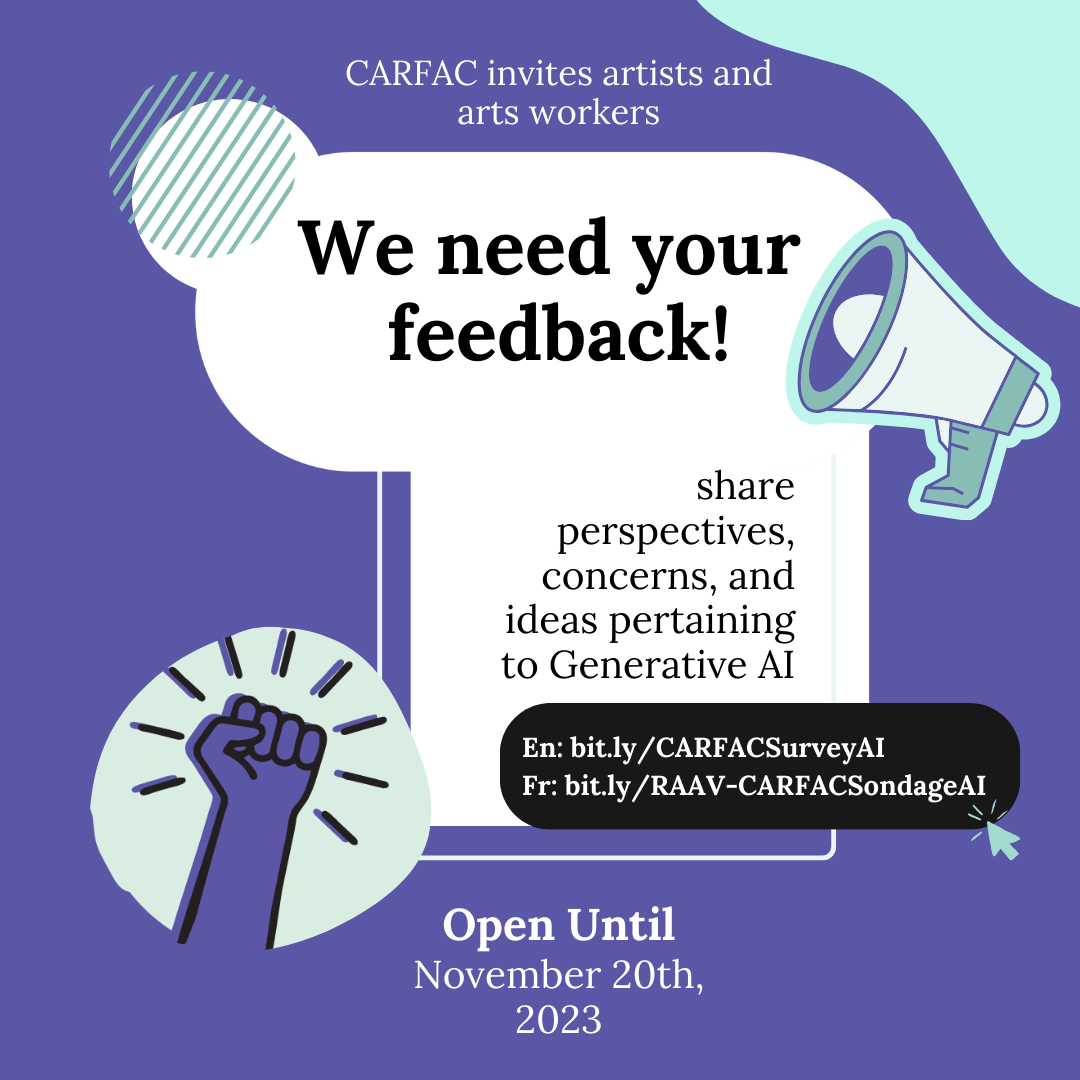
CARFAC invites Canadian artists and arts workers to share perspectives, concerns, and ideas pertaining to Generative Artificial Intelligence (AI). Participating in this short survey will help to inform CARFAC’s advocacy and policy recommendations in the weeks and months ahead. Your personal information is not required. 

The survey will be open until November 20th, 2023. 

Survey link: 

En—bit.ly/CARFACSurveyAI

Fr—bit.ly/RAAV-CARFACSondageAI

2023 Ontario Pre-Budget Consultations

As part of the the 2023 Pre-Budget consultations, CARFAC Ontario recommended that the Government of Ontario in its 2023 budget:

Sustain the 2022 level of investment in the Ontario Arts Council (OAC) at $65 million

Founded in 1963 by Progressive Conservative Premier John Robarts, the Ontario Arts Council’s work touches all almost all of Ontario’s cultural economy which, in 2019, contributed $28.7 billion to the provincial GDP. This includes $5.5 billion GDP contribution from arts education, performing arts, festivals, original visual art, craft, books, and sound recordings—sectors that are heavily supported by the OAC. In 2021-22, OAC made investments in all 124 Ontario ridings through 2,665 grants to individual artists, and 1,050 grants to organizations.

The arts sector is grateful for the additional investment of $5m to OAC’s general grant in 2022, which, per OAC’s projections has the potential to generate an additional $79m in revenues, along with 4800 new jobs. As such, we highlight that sustaining this funding can result in significantly more economic growth. In addition to its direct GDP contribution, the arts and culture sector plays a central role in driving tourism and enhancing local business, as well as creating jobs, with over 300,000 Ontarians currently employed in the sector.

Ontario cannot afford to fall behind. Previous governments have not pursued the economic impact directly associated with investment at the OAC, with the Council’s general grant from the province remaining at or around $60m since 2009; and these annual investments have not reflected population growth or inflation. While Ontario is home to approximately 42% of Canada’s artists (almost twice as much as any other province), between 2016 and 2022 British Columbia and Quebec have more than doubled their investments in their provincial arts councils. During this challenging time, sustaining a $65m general grant for the OAC represents an effective strategy to stabilize, and protect, the arts and culture sector’s economic impact.     

The full submission can be read and downloaded here.

For more information please contact: Jason Samilski, Managing Director, CARFAC Ontario | jason@carfacontario.ca

PASO-OPSA Coalition Identifies Provincial Arts & Culture Policy Priorities | La coalition PASO-OPSA identifie les priorités en matière de politique artistique et culturelle

CARFAC Ontario is a member of Provincial Arts Service Organizations/Organisations Provinciale de Services aux Arts de l’Ontario (PASO-OPSA), a coalition of Ontario Arts Service Organizations that, collectively, acts as a conduit to over 272,000 creative workers, and artists across the province, as well as to thousands of organizations, large and small, that create and support artistic expression in Ontario.

The coalition has collectively identified key priorities for Ontario’s arts sector around which it is aligned, and will champion, as we move though the COVID-19 pandemic. As such, PASO-OPSA recommends that the Government of Ontario:

1. Commit to Truth and Reconciliation in arts and culture.

The Government of Ontario should establish a permanent $10 million annual fund for Indigenous artists, cultural leaders, organizations, groups and collectives that is designed and managed by Indigenous artists.

2. Increase investment in the Ontario Arts Council (OAC).

Funding for the OAC has fallen dangerously behind the growth of the sector. When inflation and population growth are taken into account, to simply keep in line with 1991 investment levels, the OAC requires a permanent base budget of $110 million in 2022. In 2021, the OAC’s base budget was $60 million

3. Embrace the role of the arts in a range of areas of provincial jurisdiction, and facilitate connections between ministries to accomplish this.

The Government of Ontario should leverage the powerful creative and innovation assets of Ontario’s arts community by acknowledging its contributions to, and ability to advance, fields such as health, mental health, education, entrepreneurship, and to engage with other sectors to address crises such as systemic racism, and others.

4. Ensure that anti-racism, and principles of fairness and justice, are embedded in all provincial programs and services.

This includes: recognizing that artists who identify as members of equity-seeking groups, as well as grassroots arts initiatives, have disproportionately faced systemic barriers to accessing support, and require low-barrier and accessible funding; working in partnership with arts organizations to hear and learn from smaller grassroots arts and cultural initiatives with the intention of informing the development of province’s arts and cultural priorities and policies. The next Government of Ontario can ensure the Ontario Human Rights Code is being upheld by evaluating the systemic barriers and exclusions that exist in, and may be perpetuated by, its investments and programs.

5. Foster the advancement of young people to participate, and provide vision and leadership in the arts.

This includes: mentorship opportunities for new-generation artists and cultural leaders, intergenerational connections between established and emerging arts leaders; supporting connections between grassroots groups and major institutions that encourage learning and transformation for all participants.

6. Work towards reducing Ontario’s carbon emissions and environmental impact.

The Government of Ontario should acknowledge that reducing emissions requires not only policy and legislation, but large-scale cultural and paradigm shifts by investing in cross-sectoral collaborations between the arts sector and Indigenous communities, climate researchers, social and behavioural scientists, industry leaders, organizations advancing awareness of environmental issues, and others. This also includes supporting the arts and culture sector to research, design, and implement sustainable and energy efficient venues and buildings; and develop strategies for sustainable touring and large-scale production.

7. Recognize the need for, and current lack of, appropriate physical and digital infrastructure.

This includes: establishing a permanent funding program to support renovations, capital projects, and new builds for arts and culture organizations. This program should also provide grants for organizations and smaller groups to support short term access to space, support the capacity of organizations to digitize collections and present digitally, and support upskilling and training. The government must also address the lack of broadband internet access which disproportionately impacts Northern Ontario communities.

8. Increase investment in arts education in Ontario’s publicly-funded schools.

The Government of Ontario should engage arts sector stakeholders to maintain, design, and update curricula that is contemporary and relevant to Ontario’s diverse population, and ensure sufficient physical and human resources are in place to deliver them. It should also investigate the current disparities in publicly-funded specialized arts schools, and ensure equitable access for racialized students and students from low-income households.

9. Amplify the majority of Ontarians’ voices by working toward a Federal Basic Income Guarantee.

This includes: advocating and working with the Federal Government on the development and implementation of a Basic Income Guarantee; shifting existing provincial income support systems toward Basic Income principles that require less conditionality and provide recipients with more autonomy; implement an Ontario Basic Income demonstration program targeting low-income artists, gig-workers, and other precariously employed Ontarians for inclusion.

We are available to provide additional details on each of this recommendations, and we encourage the Government of Ontario to work in concert with PASO/OPSA members to envision the path forward for Ontario’s vibrant arts community.

For more information, please contact:

Jason Samilski, Managing Director, CARFAC Ontario | jason@carfacontario.ca

PASO/OPSA Coalition Members

Alliance culturelle de l‘Ontario

Artist-Run Centres & Collectives of Ontario (ARCCO)

ArtsBuild Ontario

Association des auteures et auteurs de l’Ontario français

Association des professionnels de la chanson et de la musique (APCM)

Association for Opera in Canada

Bureau des regroupements des artistes visuels de l’Ontario (BRAVO)

Canadian Alliance of Artists – East Chapter

Canadian Artists’ Representation / Le front des artistes canadiens (CARFAC Ontario)

Canadian Music Centre

Choirs Ontario

Craft Ontario

Cultural Pluralism in the Arts Movement Ontario (CPAMO)

Dance Ontario

Dance Umbrella of Ontario

Directors Guild of Canada (Ontario)

Folk Music Ontario

FUSION – The Ontario Clay and Glass Association

Galeries Ontario / Ontario Galleries (GOG)

Ontario Culture Days

Ontario Presents

The Association for Opera in Canada (Opera.ca)

Orchestras Canada/Orchestres Canada

Réseau Ontario

Théâtre Action

Toronto Alliance for the Performing Arts (TAPA)

WorkInCulture

_________________________________________

CARFAC Ontario est membre de Provincial Arts Service Organizations of Ontario/Organisations Provinciale de Services aux Arts de l’Ontario (PASO/OPSA), une coalition d’organismes de services aux arts de l’Ontario qui, collectivement, agit comme intermédiaire pour plus de plus de 272 000 travailleurs créatifs et artistes à travers la province, ainsi que des milliers d’organismes, petits et grands, qui créent et soutiennent l’expression artistique en Ontario.

La coalition a collectivement identifié des priorités clés pour le secteur des arts de l’Ontario, autour desquelles elle s’aligne et qu’elle soutiendra activement au fur et à mesure que nous progressons dans la pandémie de la COVID-19. Ainsi, la PASO-OPSA recommande au gouvernement de l’Ontario de:

1. S’engager en faveur de la vérité et réconciliation dans les arts et la culture.

Le gouvernement de l’Ontario devrait créer un fonds annuel permanent de 10 millions de dollars pour les artistes, les leaders culturels, les organisations, les groupes et les collectifs Autochtones, conçu et géré par des artistes Autochtones.

2. Augmenter l’investissement dans le Conseil des arts de l’Ontario (CAO).

Le financement du CAO a dangereusement pris du retard par rapport à la croissance du secteur. Si l’on tient compte de l’inflation et de la croissance de la population, pour simplement demeurer au niveau d’investissement de 1991, le CAO nécessite un budget de base permanent de 110 millions de dollars en 2022. En 2021, le budget de base de la CAO était de 60 millions de dollars

3. Reconnaître le rôle des arts dans de nombreux domaines de compétence provinciale et faciliter les échanges inter-ministériels à cette fin.

Le gouvernement de l’Ontario devrait mettre à profit les atouts considérables de la communauté artistique de l’Ontario en matière de création et d’innovation en reconnaissant sa capacité et ses contributions à l’avancement des domaines tels que la santé, la santé mentale, l’éducation et l’entrepreneuriat, et faire appel à la collaboration entre secteurs pour résoudre des problématiques telles que le racisme systémique, entre autres.

4. S’assurer que l’antiracisme et les principes d’équité et de justice sont intégrés dans tous les programmes et services provinciaux.

Cela comprend : la reconnaissance du fait que les artistes qui s’identifient comme membres de groupes marginalisés, ainsi que les programmes artistiques communautaires, ont été confrontés de façon disproportionnée à des obstacles systémiques à l’accès au soutien, et nécessitent un financement plus accessible et à faible barrière. Le gouvernement doit travailler en partenariat avec des organismes artistiques afin d’apprendre des plus petites organisations communautaires et culturelles dans le but d’informer le développement des priorités et des politiques artistiques et culturelles de la province. Le prochain gouvernement de l’Ontario peut s’assurer que le Code des droits de la personne de l’Ontario est respecté en évaluant les obstacles et les exclusions systémiques qui existent dans ses investissements et ses programmes et qui peuvent être perpétués par ceux-ci.

5. Favoriser l’avancement des jeunes afin qu’ils puissent contribuer et offrir un nouveau point de vue et du leadership dans les arts.

Cela comprend : des possibilités de mentorat pour les artistes et les leaders culturels de la nouvelle génération, des contacts intergénérationnels entre les leaders artistiques établis et émergents, le soutien des échanges entre les groupes communautaires et les grandes institutions qui encouragent l’apprentissage et la valorisation de tous les participants.

6. Travailler à la réduction des émissions de carbone et de l’impact environnemental de l’Ontario.

Le gouvernement de l’Ontario devrait reconnaître que la réduction des émissions nécessite non seulement des politiques et des lois, mais aussi des changements culturels et paradigmatiques à grande échelle, en investissant dans des collaborations entre le secteur des arts et les communautés Autochtones, les chercheurs en matière de changements climatiques, les sociologues et les spécialistes du comportement, les chefs de file de l’industrie, les organismes de sensibilisation aux enjeux environnementaux, etc. Il est également important de soutenir le secteur des arts et de la culture dans la recherche, la conception et la mise en œuvre de lieux et de bâtiments durables et écoénergétiques, et d’élaborer des stratégies de tournée et de production à grande échelle durables.

7. Reconnaître la nécessité et l’absence actuelle d’une infrastructure physique et numérique adéquate.

Cela comprend : l’établissement d’un programme de financement permanent pour soutenir les rénovations, les projets d’immobilisations et les nouvelles constructions des organismes artistiques et culturels. Ce programme devrait également recevoir des subventions pour les plus petits organismes afin de faciliter l’accès à court terme à des bureaux, de soutenir la capacité des organismes à numériser leurs collections et à les présenter sous forme numérique, et de soutenir la formation et le développement professionnel. Le gouvernement doit également s’attaquer au manque d’accès à l’Internet à haute vitesse qui a un impact disproportionné sur les communautés du Nord de l’Ontario.

8. Investir davantage dans l’éducation artistique dans les écoles financées par les fonds publics de l’Ontario.

Le gouvernement de l’Ontario devrait faire appel aux intervenants du secteur des arts pour maintenir, concevoir et mettre à jour des programmes d’études contemporains qui tiennent compte de la population très diversifiée de l’Ontario, et s’assurer que des ressources physiques et humaines suffisantes sont en place pour les offrir. Il devrait également enquêter sur les disparités qui existent actuellement dans les écoles d’arts spécialisées financées par les fonds publics, et veiller à ce que les élèves appartenant à des groupes marginalisés et aux ménages à faible revenu y aient un accès équitable.

9. Supporter la majorité des Ontariens en travaillant à la mise en place d’un revenu de base garanti fédéral.

Cela comprend : plaider et travailler avec le gouvernement fédéral sur le développement et la mise en œuvre d’une garantie de revenu de base ; faire évoluer les systèmes provinciaux de soutien au revenu existants vers les principes du revenu de base nécessitant moins de conditions et offrant plus d’autonomie aux bénéficiaires ; mettre en œuvre un projet pilote du revenu de base en Ontario ciblant les artistes à faible revenu, les travailleurs autonomes et d’autres Ontariens à l’emploi précaire pour les inclure.

Nous sommes disponibles pour vous fournir plus de détails sur chacune de ces recommandations, et nous encourageons le gouvernement de l’Ontario à travailler de concert avec les membres de la PASO/OPSA pour envisager la voie à suivre pour la communauté artistique dynamique de l’Ontario.

Pour plus d’informations, veuillez contacter: jason@carfacontario.ca 

Membres de la coalition PASO/OPSA

Alliance culturelle de l’Ontario
Centres et collectifs d’artistes autogérés de l’Ontario (ARCCO)
ArtsBuild Ontario
Association des auteures et auteurs de l’Ontario français
Association des professionnels de la chanson et de la musique (APCM)
Association pour l’opéra au Canada
Bureau des regroupements des artistes visuels de l’Ontario (BRAVO)
Alliance canadienne des artistes – Chapitre de l’Est
Canadian Artists’ Representation / Le front des artistes canadiens (CARFAC Ontario)
Centre de musique canadienne
Choirs Ontario
Craft Ontario
Pluralisme culturel dans le mouvement artistique Ontario (CPAMO)
Dance Ontario
Dance Umbrella of Ontario (en anglais seulement)
Guilde canadienne des réalisateurs (Ontario)
Folk Music Ontario
FUSION – L’Association ontarienne de l’argile et du verre
Galeries Ontario / Ontario Galleries (GOG)
Fête de la culture de l’Ontario
Ontario Presents
L’Association pour l’opéra au Canada (Opera.ca)
Orchestras Canada/Orchestres Canada
Réseau Ontario
Théâtre Action
Toronto Alliance for the Performing Arts (TAPA) (en anglais seulement)
WorkInCulture

ODSP & ARTS GRANTS 101

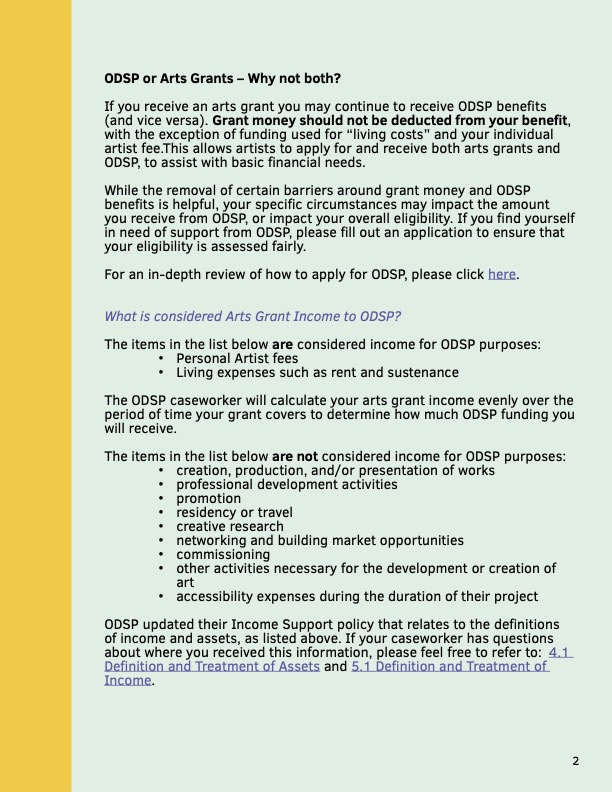
This ODSP & ARTS GRANTS 101 document, compiled in March 2022, has been created by Pro Bono Students Canada volunteers from the Lincoln Alexander School of Law chapter and CARFAC Ontario. It is our intention to provide accessible information to those who may need it, in relation to ODSP qualification requirements and arts grants.

To download the document, click here.

We’ve created an audio-visual version for accessibility, that can be found here.

Recommendations for Ontario’s 2022 Budget

In January 2022, CARFAC Ontario submitted to the Government of Ontario’s Standing Committee on Finance and Economic Affairs a series of recommendations for arts and culture investments for the upcoming 2022 Budget:

1. Increase the Ontario Arts Council’s (OAC) base budget to $95 million annually.

2. Establish a permanent $10 million fund to support Indigenous artists, cultural leaders, organizations, groups and collectives.

3. Maximize the value of any additional arts investments (through strategizing delivery, increasing consultation, as well as allocating commitments made in Budget 2021)

4. Amplify the majority of Ontarians’ voices by working toward a Federal Basic Income Guarantee.

For more detail and rationale on each of these recommendations, please click here to read the full brief.

Open letter: Canadian artists urgently need a social safety net

October 19, 2021

The Hon. Chrystia Freeland, Deputy Prime Minister and Minister of Finance

The Hon. Carla Qualtrough, Minister of Employment, Workforce Development and Disability Inclusion

The Hon. Steven Guilbeault, Minister of Canadian Heritage

Re: Canadian artists urgently need a social safety net

Dear Ministers,

As we are still experiencing a fourth wave of the COVID-19 pandemic, Canadian artists urge the Federal Government to extend emergency income support for self-employed and gig workers, with a view to finding a long-term social safety net for our sector.

We applaud the Government’s leadership in working with us to best support self-employed workers with the introduction of Canada Emergency Response Benefit and Canada Recovery Benefit during this very difficult time. This support has been a lifeline for many cultural workers, and we appreciate the Government’s commitment to help artists and the cultural industries recover, because as you know: we were among the first to close and we will be among the last to recover. Beyond recovery, we welcome the opportunity to consult with you about much needed reform to Employment Insurance programs, which are often out of reach for self-employed artists when they need it most.

The Liberal Party’s platform includes commitments to implement a transitional support program for out-of-work self-employed artists, and to hold a summit within 100 days to discuss restarting our industry. Meanwhile, 750,000 Canadians are still receiving much needed support from the Canada Recovery Benefit, which is set to expire in just a few days, without that transition plan in place.

Some of them are our members, and we know they cannot wait 100 days to begin discussions about recovery without that support, and so we urge you to extend the CRB until an alternative option is in place.

We hope we can count on the Government of Canada to make this adjustment and ensure that Canadian artists will not be left behind.

Signed,

Paddy Lamb, National President of CARFAC (Canadian Artists’ Representation) 

Eleanor Noble, ACTRA National President

David Farsi, Président du Regroupement des artistes en arts visuels du Québec (RAAV)

Rhea Tregebov, Chair of the Writers Union of Canada

Sasha Sobrino, General Manager, Canadian Association of Professional Image Creators

Cc: Rebecca Caldwell, Director of Policy, Canadian Heritage

Irene Cheung, Senior Policy Advisor, Canadian Heritage

Simon Brault, Director and CEO, Canada Council for the Arts

Brief to the House of Commons Standing Committee on Finance, 2022 Pre-Budget Consultations

Primarily self-employed, visual, media, and craft-based artists derive income through various revenue streams. It is extremely rare for a single source of revenue to provide enough income to live on. It is a common practice for artists to occupy several roles, including but not limited to: creation, sales, instruction, mentorship, consultancy, speaking, curation, writing, and working for art institutions and organizations. This leads to a mixture of royalties and fees paid, sales, and wages from additional part-time jobs, such as teaching in universities or working for galleries. Many artists and cultural workers supplement their arts incomes with labour in other sectors, which often involves low-paid and/or precarious gig-work.

– According to 2016 Census data, there are 726,600 cultural workers, representing 4% of the overall labour force. This includes over 158,000 artists living and working in Canada, representing more workers than in automotive manufacturing and utilities;

– The median income of Canadian visual artists is $20,000, which is 54% lower than the median income of all workers. 66% of Canadian visual artists are self-employed, compared to only 12% of all Canadian workers;

– Of the 21,100 visual artists in Canada,16% of visual artists are Indigenous, Black, or racialized. Indigenous, Black, and racialized artists are underrepresented within Canadian cultural institutions both as presenting artists, and within executive management positions and boards. Meanwhile COVID-19 transmission has disproportionately impacted Black, racialized, and low-income communities;

– The 2016 Census revealed that Indigenous, Black, and other racialized artists earn significantly less income than their non-Indigenous/non-racialized counterparts. Indigenous, and Black and racialized artists earn a median income of 68 cents and 72 cents, respectively, for every $1 for non-Indigenous/Black/racialized artists.

Overview of recommendations
We support the recommendations made by the Canadian Arts Coalition, and the recommendations made by Galeries Ontario/Ontario Galleries.  Additionally, we recommend that the Federal Government:

1. Modernize the Employment Insurance program;

2. Advance the Canada Council for the Arts’ 2021-26 Strategic Plan by investing $2M for the creation of a high-access Micro-Grant program for artists;

3. Create a new program at Canadian Heritage to encourage and support entrepreneurship among visual artists;

4. Amend the Copyright Act to include an Artist’s Resale Right as an economic marketplace solution for individual artists.

Read the full brief.